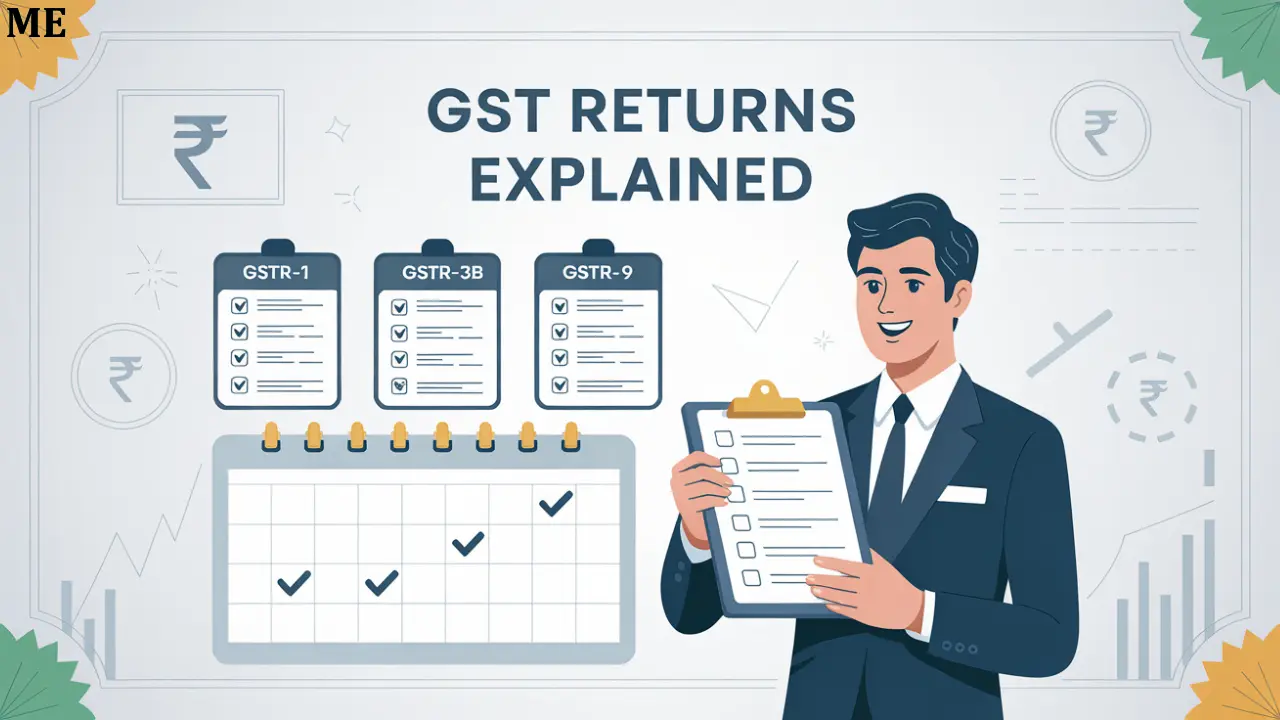
What Are GST Returns? Types of GST Return Forms, Filing Dates Filing an Income Tax Return (ITR) is mandatory for various individuals and entities in India, even if they don’t owe any tax. Here’s a summary of who needs to file: Manthan Experts July 14, 2025 GST Introduction GST Returns are forms that businesses registered under the Goods and Services Tax (GST) system must file periodically to report their sales, purchases, output GST, input tax credit (ITC), and other tax-related information. These data helps the governments to track and manage the collection of taxes also the shows the Contributions in the GDP the Country as well as state. A comprehensive summary of the different GST return formats, their required submission timeframes, and the corresponding compliance duties for businesses. Types of GST Returns Within India’s Goods and Services Tax (GST) framework, enrolled firms and taxpayers must submit various categories of GST filings depending on their business type, turnover, and registration type. Below are mentions the types of return which required to be submit or file by the registered persons. GSTR-1 – Details of Outward Supplies Who Files: Registered taxable supplier Filing Interval: Monthly submissions required (with quarterly filing options available for taxpayers who qualify under the Quarterly Return Monthly Payment scheme). Purpose: To declare specifics of all external provisions (sales) of merchandise and services. Encompasses information such as individual sales invoices, debit memos, and credit memos. Scheduled Dates: Deadline for Monthly Submitters: The eleventh day of the subsequent month. For those submitting under the Quarterly Return Monthly Payment system: Due by the 13th of the month following the quarter’s conclusion. GSTR-2A – Auto-Generated Purchase Return Who Files: No manual filing required (auto-generated) Frequency: Monthly Purpose: This is a view-only record displaying particulars of incoming acquisitions (purchases) automatically populated from the vendor’s GSTR-1. Used for input tax credit (ITC) reconciliation. GSTR-2B – Static ITC Statement Who Files: No manual filing required (auto-generated) Periodicity: Monthly (Accessible from the fourteenth of each month). Purpose: Provides a consolidated view of eligible and ineligible Input Tax Credit (ITC). Helps businesses claim ITC accurately. GSTR-3B – A consolidated return summarizing external and internal provisions. Who Files: Registered taxpayer Frequency: Required on a monthly basis (with quarterly options available for businesses registered under the QRMP program). Purpose: An overview of sales, purchase tax credit claimed, and the tax liability. Payment of tax liability. Due Dates: For Monthly Filers: 20th of the Subsequent or Next Month. For QRMPS Filers: 22 or 24 of the Subsequent or Next Month of Quarter End. GSTR-4 – Tax return submission required for businesses operating within the Composition Scheme framework. Who Must File: Taxpayers enrolled in the Composition Scheme. Frequency: Annually Purpose: An overview detailing aggregate business revenue and composition scheme tax liability. Limited reporting requirements compared to regular taxpayers. Due Date: April 30th of the subsequent fiscal year. GSTR-5 – Submitted by Non – Residents. Who Files: Non-resident taxpayers Frequency: Monthly Purpose: Reports sales and purchases made in India by non-resident taxpayers. Payment of tax liability. Due Date: 20th of the following month GSTR-5A – Return for OIDAR Services Who Files: Online Information and Database Access or Retrieval (OIDAR) service providers outside India who provide services in india. Frequency: Monthly Purpose: Particulars of services rendered to unregistered individuals within India. Payment of tax liability. Due Date: 20th of the following month GSTR-6 – Filing for Purchase Tax Credit Distribution Units (ISD). Who Files: Input Service Distributors Frequency: Monthly Purpose: Allocation of purchase tax credit (ITC) across operational units. Reports details of ITC received and distributed to their associates Due Date: 13th of the following month GSTR-7 – Return for TDS Deductors Who Files: Tax Deductors (like government departments) Frequency: Monthly Purpose: Reports details of Tax Deducted at Source (TDS) under GST. TDS certificate is auto-generated after filing. Due Date: 10th of the following month GSTR-8 – Return for E-Commerce Operators Who Files: E-Commerce Operators Frequency: Monthly Purpose: Reports details of supplies made through the E – Commerce platform. Tax collected at source (TCS) under GST on monthly basis. Due Date: 10th of the following month GSTR-9 – Annual Return Who Files: Regular taxpayers Frequency: Annually Purpose: A holistic summary of all GST filings submitted during the fiscal year. Includes data on sales, acquisitions, purchase tax credit (ITC), and tax liabilities. Due Date: 31st December of the subsequent or Next financial year. GSTR-9A – Yearly return for taxpayers under the Composition Scheme. Who Files: Composition Scheme taxpayers (Optional) Frequency: Annually Purpose: Overview of all returns submitted under the Composition Scheme throughout the financial year. Due Date: 31st December of the subsequent financial year. GSTR-9C – Reconciliation Statement Who Files: Taxpayers whose total turnover exceeds ₹5 crore. Frequency: Annually Purpose: Reconciliation of GSTR-9 with audited financial statements of relevant financial year. Certification by a Chartered Accountant (CA) is required. Due Date: 31st December of the subsequent financial year. GSTR-10 – Annual Return Who Must File: Entities whose GST registration status has been terminated or voluntarily relinquished. Frequency: Once Purpose: Reports details of closing stock and final tax liability. Due Date: Must be completed within a three-month timeframe following the cancellation notification or official order. GSTR-11 – Return for UIN Holders Who Must File: Individuals or entities holding a Unique Identification Number (UIN). Frequency: Monthly Purpose: Requests a refund for taxes paid on incoming supplies. Due Date: 28th of the following month Common GST Filing Timelines Overview Key Notes: ✅ ₹50 per day penalty is levied for late filing (₹20 for NIL returns). ✅ Delayed tax payments incur an interest charge of 18% per annum. ✅ Taxpayers enrolled in the Quarterly Return Monthly Payment (QRMP) plan are required to submit GSTR-1 and GSTR-3B on a quarterly basis yet remit taxes every month. Conclusion: Submitting GST returns correctly and promptly is essential to ensure compliance and prevent penalties. Businesses must stay on top of return filing deadlines and ensure all details are correctly reported to prevent tax issues. If you require assistance on filing any specific GST return, Manthan Experts can be your trusted advisor. Contact them at info@manthanexperts.com.to discuss your specific needs and explore how their expertise can benefit your business. Table of Contents Introduction Types of GST Returns GSTR-1 – Details of Outward Supplies GSTR-2A –… Continue reading What Are GST Returns? Types of GST Return Forms, Filing Dates

Author: Manthan Experts
Who is Required to File Income Tax Returns (ITR) in India?
Who is Required to File Income Tax Returns (ITR) in India? Filing an Income Tax Return (ITR) is mandatory for various individuals and entities in India, even if they don’t owe any tax. Here’s a summary of who needs to file: Manthan Experts August 21, 2025 Blog, Income Tax Consultancy, ITR e-Filing Who is Required to File Income Tax Returns (ITR) in India? Filing an Income Tax Return (ITR) is mandatory for various individuals and entities in India, even if they don’t owe any tax. Here’s a summary of who needs to file: 1. Companies: All companies must file ITR regardless of their profit or loss. 2. Partnership Firms: All partnership firms must file ITR regardless of their profit or loss. 3. Individuals (Resident of India): Individuals exceeding the basic exemption limit: Old Tax Regime: New Tax Regime: ₹3 Lakhs for all individuals. 4. Individuals claiming a tax refund: If TDS deductions exceed assessee’s tax liability, assessee must file ITR to claim a refund. 5. Individuals carrying forward losses: To carry forward losses incurred in a particular year, assessee must file ITR. 6. Individuals with foreign assets: Residents of India with assets or financial interests in foreign entities are required to file ITR. 7. Individuals with foreign accounts: Residents of India who are signing authorities in foreign accounts must file ITR. 8. Individuals receiving income from certain trusts/institutions: Individuals receiving income from trusts, religious institutions, educational institutions, etc., must file ITR. 9. Foreign companies seeking treaty benefits: Foreign companies seeking tax treaty benefits on transactions in India must file ITR. 10. Individuals exceeding certain financial thresholds: Individuals who have deposited more than ₹1 Crore in current accounts, ₹50 Lakhs in savings accounts, spent more than ₹2 Lakhs on foreign travel, paid electricity bills exceeding ₹1 Lakh, or had TDS/TCS exceeding ₹25,000 in the previous year. 11. Individuals engaged in business or profession exceeding certain thresholds: Individuals engaged in business with a turnover exceeding ₹60 Lakhs or in a profession with gross receipts exceeding ₹10 Lakhs. 12. Individuals with Capital Gains: If assessee have earned capital gains through the sale of assets like property, shares, etc., then assessee must file his/her returns to report these gains. 13. Taxpayers with Deductions Under Section 80: If assessee have claimed deductions for investments or expenses under sections like 80C (PPF, NSC, life insurance), 80D (health insurance), etc., then assessee must file ITR. 14. HUF (Hindu Undivided Family): A Hindu Undivided Family needs to file ITR if their total income exceeds the exemption limit. 15. Non-Resident Indians (NRIs): If assessee are an NRI and have income in India, assessee must file ITR to comply with Indian tax laws. Consequences of Not Filing ITR Penalties: Failure to file ITR within the prescribed deadline can result in penalties. Non-Tax Audit Cases: Under Section 234F, if assessee fail to file his/her ITR within the due date, a late fee of Rs 5,000 will be applicable. So, In context of the above if the annual income of assesse is below Rs. 5,00,000 then the Late Fee would be Rs. 1,000. Tax Audit Cases: ₹1,50,000 or 0.5% of Total sales, whichever is lower. If assessee missed the due date or even not filed Income Tax return upto 31 December u/s 139(4), then there is No chance of filing the Tax Return. In case assessee miss the deadline prescribed u/s 139(4), then they may file return u/s 139(8A) i.e. ITR U(Updated return) in certain specified cases. Now Let us Discuss ITR-U (Updated Return) ITR-U is a mechanism introduced under Section 139(8A) of the Income Tax Act, 1961, that allows taxpayers to update their previously filed Income Tax Returns (ITR). This is crucial because it provides an opportunity to correct errors, omissions, or discrepancies in the original return. Eligibility for Filing ITR-U Within Two Years: ITR-U can be filed within two years from the end of the relevant assessment year. For example, for the Assessment Year 2024-25 (relating to the financial year 2023-24), the deadline for filing ITR-U would be March 31, 2026. NOTE:- In the Union Budget 2025-26, Finance Minister Nirmala Sitharaman introduced key amendments to the Updated Income Tax Return (ITR-U) provisions to enhance voluntary compliance. The deadline for filing an updated return has been extended from 24 months to 48 months from the end of the relevant assessment year, allowing taxpayers more time to rectify errors, disclose unreported income, and comply with tax regulations. This revision aims to improve transparency and reduce litigation by providing a structured mechanism for correcting past tax filings while ensuring timely tax payments. Reasons for Filing ITR-U Correcting Errors: Incorrectly declared income Wrong selection of income heads Errors in tax calculations Omitted deductions or exemptions Reporting Missed Income: Including income that was not reported in the original return. Adjusting Tax Credits: Correcting errors in the calculation of tax credits. Search Table of Contents Who is Required to File Income Tax Returns (ITR) in India? Consequences of Not Filing ITR Now Let us Discuss ITR-U (Updated Return) Eligibility for Filing ITR-U Reasons for Filing ITR-U Latest Blog and News Audit & Assurance Blog Bookkeeping & Accounting GST Income Tax Consultancy ITR e-Filing Knowledge Update Payroll (PF & ESIC)